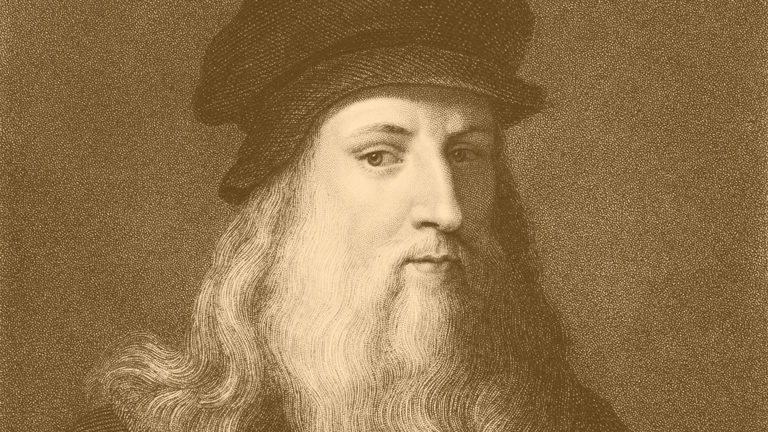
To examine the life of Leonardo da Vinci from the vantage point of 2026 is to realize that the man was not a product of the Renaissance, but a visitor to it. While his peers were perfecting the depiction of saints, Leonardo was dissecting the human heart to understand its valves and sketching the aerodynamics of bird wings to master flight. Today, as we stand in an era dominated by the integration of art and artificial intelligence, Leonardo’s “Story of Doing” has never been more relevant. He was the first truly multidisciplinary thinker a man who realized that the way water curls around a rock is governed by the same mathematical grace as the light hitting a human cheek.
The Autodidact’s Revenge: Breaking the Kensington of the Mind
Leonardo’s genius was forged in the fires of exclusion. Born on April 15, 1452, in the rural hills of Vinci, his status as an illegitimate child was his greatest hidden asset. Barred by law from his father’s lucrative profession as a notary and kept out of the rigid Latin schools of the time, Leonardo was spared the “Kensington System” of his day the stifling, dogmatic education of the 15th-century elite. Instead, he became a self-described disciple of experience. While other boys were memorizing dusty Greek texts, Leonardo was out in the Tuscan sun, observing the mechanics of a dragonfly’s wing. By the time he entered Verrocchio’s workshop in Florence at fourteen, he hadn’t just learned to paint; he had learned how to see.
Military Engineering and the Milanese Power-Plays
If you were to look at Leonardo’s resume in 1482, you wouldn’t find a painter looking for a gallery. You would find an engineer looking for a war. In his famous letter to Ludovico Sforza, the Duke of Milan, Leonardo spent ten paragraphs detailing his designs for armored tanks, portable bridges, and giant crossbows, only mentioning at the very end that he could also “sculpt and paint as well as any other.” This was the “Story of Doing” in its purest form. During his twenty years in Milan, he wasn’t just pondering the divine; he was designing a “mechanical knight” and diverting rivers for military defense. This investigative side of his career reveals a man who viewed art not as a hobby, but as a byproduct of understanding engineering and anatomy.
The $450 Million Signature: The Net Worth of an Icon
In the modern financial landscape, the Leonardo da Vinci “brand” is the most valuable intellectual property in human history. While the man lived on the patronage of kings and died with a modest estate of scientific papers, his legacy in 2026 is measured in staggering numbers. The 2017 sale of the Salvator Mundi for 450.3 million dollars remains the high-water mark for any object ever sold at auction. But his true “net worth” isn’t found in a single canvas; it is found in the Codices his personal notebooks. When Bill Gates purchased the Codex Leicester for 30.8 million dollars, he wasn’t buying paper; he was buying the source code of the modern mind. In 2026, these documents are being utilized by researchers to study his early concepts of friction and fluid dynamics, proving that Leonardo’s intellectual assets are still paying dividends five centuries later.
The Final Act at Clos Lucé: An Engineer in Exile
The final chapter of Leonardo’s life, spent as a guest of King Francis I in France, was a period of frantic organization. At the manor of Clos Lucé, he didn’t stop doing; he simply pivoted from creation to curation. Surrounded by his vast collection of anatomical studies and hydraulic plans, he spent his last years trying to prove that everything in nature was connected. When he died on May 2, 1519, he did so not as a simple painter, but as a First Architect and Engineer. He requested that sixty beggars follow his casket a final act of humility from a man who had spent his life deciphering the complex mechanics of the world but never lost touch with the basic human experience.
The Enduring Blueprint
Leonardo da Vinci’s biography in 2026 is no longer a static museum piece; it is an active blueprint for the 21st-century polymath. He proved that the silos we build between “science” and “art” are entirely artificial. From the chemical composition of his Sfumato shadows to the mathematical precision of the Mona Lisa’s gaze, he showed us that to truly master one thing, you must observe everything. As we navigate our own age of rapid technological shifts, the boy from Vinci remains the ultimate reminder that curiosity, backed by rigorous action, is the most powerful engine in the world.